 de
 fr
 nl
 en



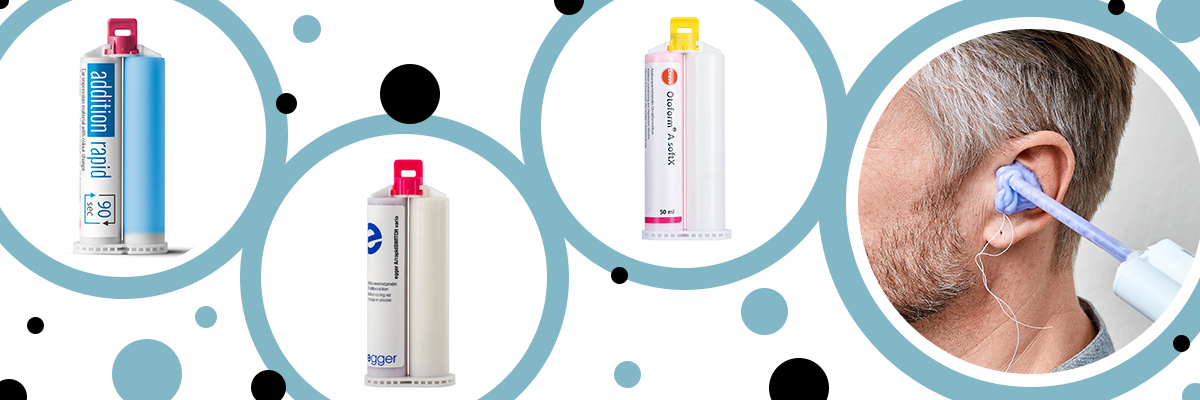
Three leading impression material brands, always within reach
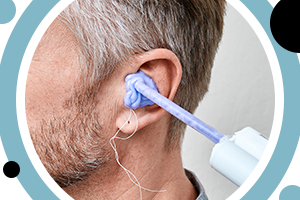
Impression material for ear impressions: choosing the right product for every situation
What should you pay attention to when choosing the right impression material, and are there actually differences between the quality brands Egger, Dreve and Detax? In this article, and with the help of our practical decision guide, we take you through it step by step, so you arrive at an accurate, comfortable and time-efficient impression.
Why the choice of impression material matters
An ear impression forms the basis for every custom-made earmold or hearing protection. If the impression is not accurate, this directly affects the fit and wearing comfort of the final product. With three quality brands and dozens of variants in the range, however, the choice is not always easy. This article gives you an overview of the most important properties and a framework for arriving at the right material for each situation.
Two mixing systems: cartridge and pot
Impression material always consists of two components that are mixed just before use. With a cartridge system, this happens automatically and in a dosed manner via the impression gun, resulting in a consistent mixing result. With a pot system, you mix it yourself, on a mixing pad with a mixing spatula, in the specified mixing ratio, and apply the material with an impression syringe. Which system works best mainly depends on the audiologist's preference and way of working.
Client situation as the starting point
The first step in choosing impression material is mapping out the client's situation. Three factors are decisive here: the client's age, the degree of hearing loss, and the type of ear canal, ranging from narrow to average to large. This combination determines which material properties are desirable and therefore forms the starting point of every choice, even before looking at viscosity, pressure build-up or Shore hardness.
Properties: viscosity, pressure build-up, Shore
Viscosity and pressure build-up
Viscosity, also known as consistency, indicates how fluid the impression material is at the moment of application. A low viscosity means a very fluid and soft material, which builds up almost no pressure in the ear canal and flows easily into the smallest folds. This provides an accurate representation of fine details without stretching the tissue, making it suitable for deep ear canal impressions and sensitive (children's) ears. A higher viscosity results in a thicker mixture that offers more resistance during injection but stays in place better during curing.
Shore
Shore, expressed on the Shore A scale, indicates the hardness of the cured material and is closely related to the tensile strength of the impression. With a higher Shore value, the material is stiffer and less flexible, meaning it moves less easily through a pronounced narrowing in the ear canal and is more likely to tear at the thinnest points. A lower Shore value results in a more flexible material that gives way more easily during removal, although a material that is too soft can tear at thin points. It is therefore always a trade-off between firmness for accuracy and flexibility for safe removal.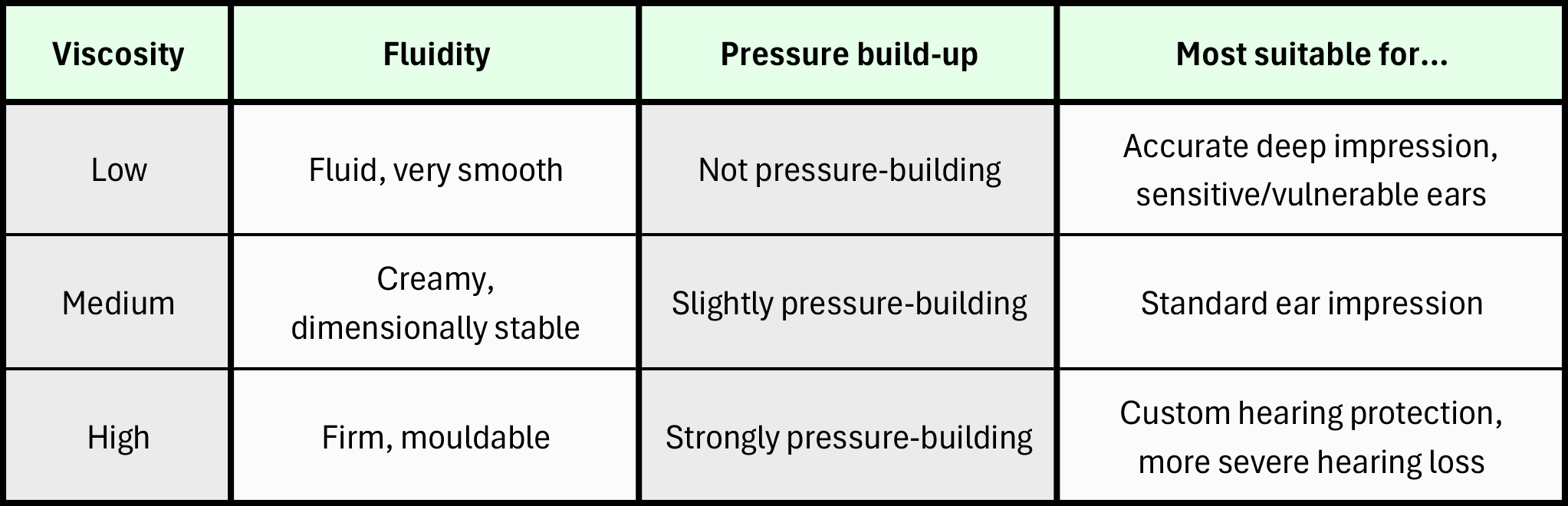
Curing time: comfort and time savings
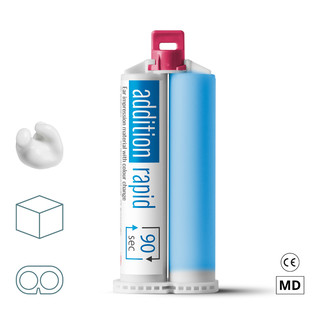
Standard impression material is sufficient for most situations. Within this standard segment, a rapid-curing variant is also available, which cures in around 90 seconds instead of the usual 180 seconds. A colour indicator in the material shows when the impression in the ear has cured sufficiently. This offers two advantages: more comfort for the client, as the material needs to stay in the ear for a shorter time, and time savings for the audiologist in daily practice.
Type of impression gun, cartridge and mixing tip
With a cartridge system, the cartridge determines which impression gun and mixing tip are needed. There are two cartridge variants: with an angular or a round connection. For the material itself, this choice makes no difference, although the market is increasingly moving towards the round variant.
Cartridge with angular connection | automix 1
A cartridge with an angular connection, also known as automix1, is compatible with the DMA-50 impression gun and matching mixing tips with a rectangular connection, in transparent with a cobalt blue or white spiral.
Cartridge with round connection | automix 2
A cartridge with a round connection, also known as automix2 or S50, is compatible with the S50 impression gun and matching round mixing tips in pink, yellow or green.
Mixing tip
Mixing tips are available in various diameters: 5.7 mm for a narrow ear canal or for children, 6.75 mm as the standard and most commonly used size, and 8.0 mm for stiffer impression material.
Swim plugs: the impression as the final product
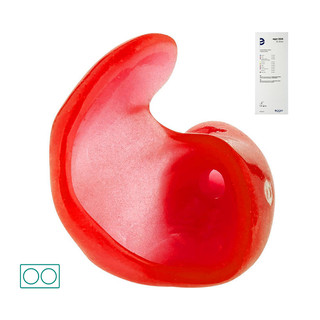
For impression material used for custom earmolds and custom hearing protection, the impression serves as the basis for further processing in the laboratory. For swim plugs, it is possible to choose a material that cures in the ear canal and directly results in the final product itself, without an intermediate step. This is called the direct method. Because the colour of the impression material also determines the colour of the final product, this material is offered in many colours. In addition, this impression material has the property of being buoyant, so that a swim plug that accidentally comes loose does not immediately sink and get lost.
Egger, Dreve and Detax | three quality brands
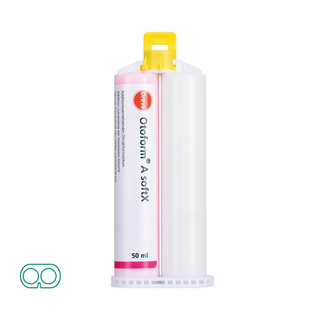
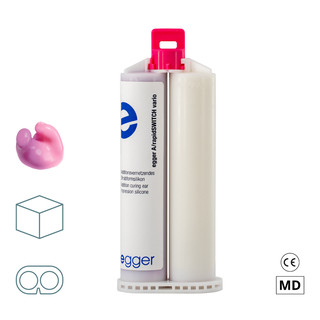
BB Hearing offers impression material from three renowned German manufacturers: Egger, Dreve and Detax. All these manufacturers produce according to the highest quality standards and hold the required Medical Device qualifications. The difference between the brands therefore lies not so much in quality, but mainly in handling feel and personal preference. Which brand is most suitable therefore mainly depends on which one you personally prefer working with.
Consulting the overview and decision guide
To support you in making the right choice, we offer an overview of all types of impression material from our range, with the relevant specifications and the situations in which the material can be used. A handy decision guide will soon be added, bringing together the steps from this article: client situation, desired material properties, and required tools and accessories. This way, you will quickly know which questions to ask yourself to arrive at the right material. View the complete overview here already.
Ordering impression material through BB Hearing
BB Hearing's range of impression material is available in the Client Portal, with a clear overview of all variants. As a B2B customer, you can easily order online and count on fast delivery, so you never run out of material. View the complete range of impression material here.
disclaimer
This knowledge base article and decision guide have been compiled with the greatest possible care, based on information from the manufacturers. No rights can be derived from the information provided. The manufacturer's instructions for use are leading.
Do you have any tips, questions or additions regarding the above information? We would love to hear from you!